

Be part of the next generation of digital health innovators.
Programme structure
The four-year programme will enable you to embark on a substantial research project, building on a tailored training programme including:
Lectures on the programme’s key themes, as well as regular guest seminars from industrial/clinical collaborators.
Training in research skills and methods, responsible and sustainable innovation, systematic literature reviews, ethics, public engagement and PPIE.
Technical training e.g. scientific computing, coding, materials and devices, prototyping and product design
Students will also benefit from:
Our annual doctoral conference, bringing together current students and expert digital health scientists
Partner ‘sandpits’, providing the opportunity to develop research ideas with real-world impact
A 3-month industry/clinical secondment in Year 1
Clinical shadowing scheme (Year 2 onwards)
See below for more detailed information about programme structure and activities:
-
Year 1 of the programme is a comprehensive training year. All CDT students will engage with the training year before starting their PhD project in Year 2.
Auditing interdisciplinary modules in term 1 and term 2. CDT Mentors work with students to identify suitable modules to develop skills ahead of research.
Theme-related lectures including external guest seminars
Weekly Journal Club. Students at UCL and UU will meet weekly to critically review and discuss literature relevant to the field and develop academic presentation skills.
Core research skills workshops across 4 dedicated training weeks. The training weeks will provide an opportunity for students at both institutions to come together in person and visit the partner university. Workshops include: Responsible Research and Innovation, MatLab, Digital Product Management, PPIE, Ethics & Public Engagement.
Core technical skills such as: programming, AI & machine learning, materials, devices, prototyping/product design, human-computer interaction/UX and behavioural science.
Mini research project. A 6-8 week taster project to build student understanding of independent research processes and build on general Digital Health Technology research principles.
3 month secondment with an industrial or clinical digital health partner. Each student will have the opportunity to gain real world experience through a secondment in the summer. Our dedicated staff at each institution will support the process.
Selection of the PhD project. In Term 1 and 2 students will meet with prospective supervisory teams to identify a project their fits their research interests.
-
From Year 2 onwards, students will focus on their chosen PhD project and will have the opportunity to be involved with centre-led opportunities as outlined below.
Events: Annual Conference, stakeholder and partner networking and engagement, student presentations and keynotes, annual challenges and competitions (e.g datathon/hackathon), research prizes and awards and project generation sandpits.
Cohort Building: Journal clubs, writing hubs, partner seminars and networking activities
Clinical Shadowing
Transferrable & Commercial Skills Training: Entrepreneurial mindset, medical device regulation, technical standard (HL7 fhir), presentation training, grant writing, project management, leadership and teamwork training
Specialised technical skills training (including industry led training): Sensor technologies, DSP, data handling/sharing, image processing
EDI, Sustainability and wellbeing activities: Information seminars (e.g. undertaking a PhD while parenting), resilience training, green computing, open-source technology, reusable code..
Career Counselling & Career Training activities: Careers workshops with employers, CV clinics, research-teaching nexus training, postdoctoral fellowship support, three minute thesis (3MT) competition.
Patient and Public Involvement and Stakeholder engagement: PPI training, digital storytelling workshop to help communicate research, media training, public co-production living lab events, policy briefing reporting, digital health hackathons/datathons
The programme will consist of four themes, as below. All research will be based in one of the four areas:
-
Timely identification of disease strongly influences the outcome and the cost of healthcare, but stretched resources and waiting lists mean new technological solutions are needed to ensure people are diagnosed promptly.
Example projects:
Breath analysis device for cancer-screening
Smartphone-based retinal scanning in the home
Decision support tools for dementia diagnosis using blood-based biomarkers
-
Efficiency and health economics are at the heart of modern healthcare. New tools and methods can improve patients’ care pathways.
Example projects:
Deep learning models for patient pathway prognostics
Drones to support public access defibrillator delivery
Point-of-care sensors for patient-specific dosing of drugs
-
Population disease surveillance is crucial to protect people, health systems and the economy from the threat of infectious diseases.
Example projects:
Mobile phone-connected sensors for self-testing of influenza
Ultra-sensitive quantum sensors for environmental surveillance of infectious diseases in wastewater
Automated assessments of an individual’s risk of disease via web search activity
-
Healthcare generates about 30% of all data globally, and NHS data could create value worth around £9.6 billion each year.
Individuals also generate their own health data through apps and wearables that are yet to be interoperable and integrated into care records.
It is vital to create health data systems to allow for secure data sharing.
Example projects:
Data visualisation to mitigate AI automation bias in radiology
Data analytics of medical device/software user interaction data for real-world validation and post-market surveillance
ECG data classification for improved diagnostics using explainable deep learning
A student’s view:
“Being part of the Tech4Health PhD programme has been genuinely valuable. The first year provided space to build necessary skills through taught modules aligned with specific interests. The industry placement and opportunities to attend and present at conferences offered especially helpful firsthand experience before stepping fully into PhD research.
The programme's flexibility allows for choosing from many project ideas submitted by different supervisors across a wide range of topics. This freedom at each stage helps build preparation and confidence when moving toward finalising the PhD topic in the second year.”
Jenson Jacob, Second Year tech4health PhD Researcher
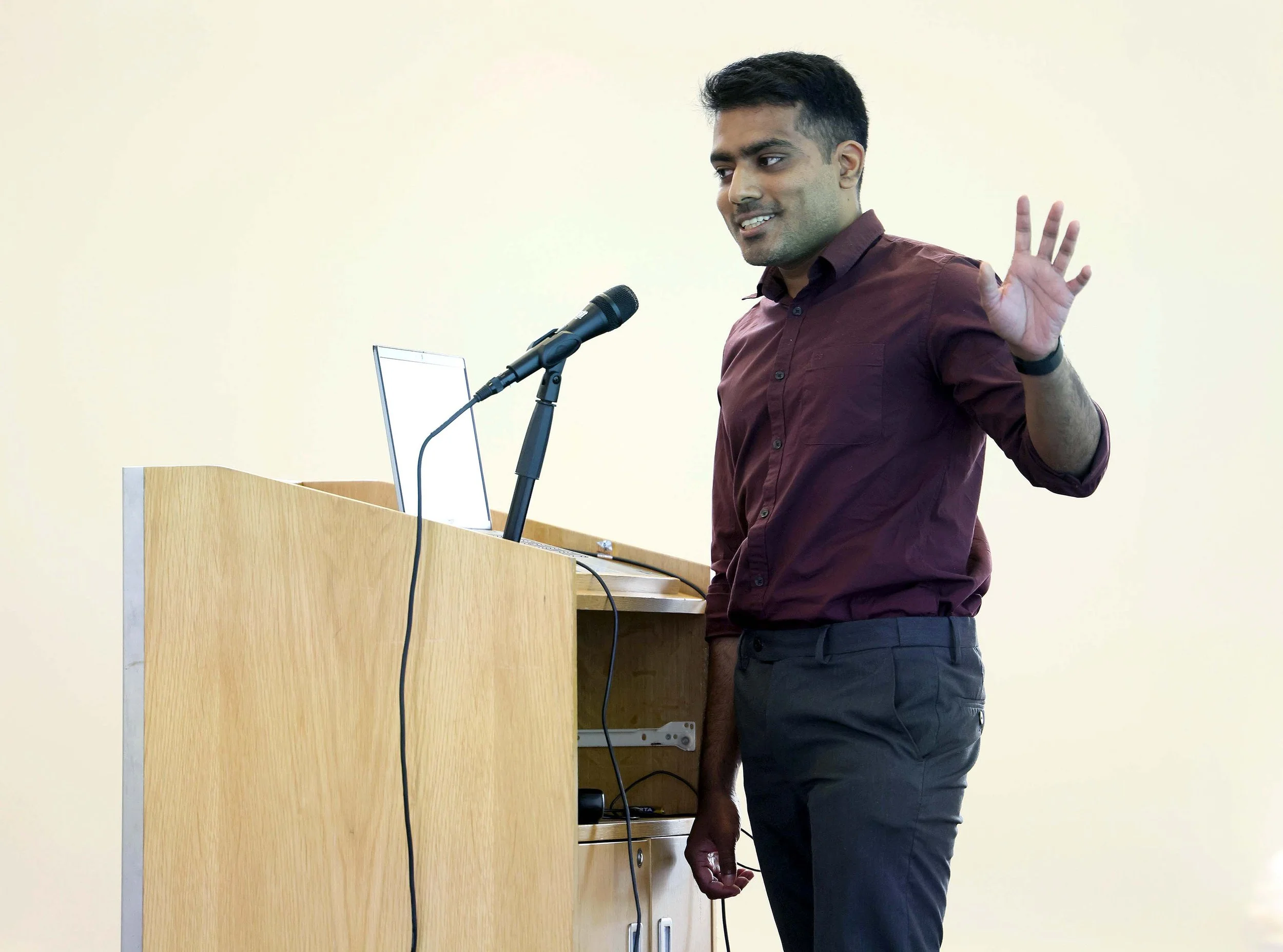
Jenson Jacob presenting his work at the tech4health annual conference 2025
